
How to Search Cook County Court Records
The Clerk of the Circuit Court of Cook County runs the public online case information service. The Clerk warns that the online docket is not the official court record. It is a public service for general status of historical and active cases. Full case files stay in hard-copy form at the courthouse or in the Clerk's other repositories. Updates may take a few days to appear online, so a fresh filing may show up first on the Public Access Terminals inside a courthouse.
The Illinois Courts page at illinoiscourts.gov confirms that circuit courts are Illinois trial courts of original jurisdiction and that circuit clerks are elected county officials. The screenshot below shows the same Illinois Courts page that explains the trial-court role and the elected clerk structure.
Use the steps below to run a basic Cook County Court case search. Have your case number ready if you can. Search by case number cuts down the result list and avoids the $6 per year search fee on the paper Clerk request form.
- Open the Clerk's online case information page and read the public-service disclaimer.
- Follow the link to the case search application at casesearch.cookcountyclerkofcourt.org.
- Choose the division to search. The County Division is one of several; civil, law, chancery, domestic relations, probate, and traffic dockets each have a search target.
- Enter the case number exactly, or search by party name if the public search exposes that filter for your division.
- Read the docket. Look for filing date, case status, party caption, judge, courtroom, hearing date, and event entries.
- For certified or full copies, file the Clerk's Record Search Request Form CCG0026 or visit the Clerk's office at the courthouse.
Illinois-licensed attorneys and justice partners use the separate CCC Portal at cccportal.cookcountyclerkofcourt.org for Criminal, County, Probate, and Domestic information. The Clerk's case lookup page sends registered attorneys to that portal. Members of the public should not register on CCC Portal; the Clerk says unauthorized registrations are denied.
The Cook County Judicial System
Illinois uses a three-tier judiciary. The Supreme Court of Illinois sits at the top. The Illinois Appellate Court is the intermediate review court, and Cook County is in the First District. The Circuit Court of Cook County is the trial court of original jurisdiction. The court hears nearly every kind of state case filed in Chicago and suburban Cook County. The Illinois Courts public guide walks through how a case moves through that hierarchy.
The public guide is shown below; it is a useful starting point for anyone trying to picture how a Cook County matter can move up to appellate review.
The Circuit Court of Cook County is unusual because it is large and unified. The court divides work into a County Department and a Municipal Department. The County Department has subject-matter divisions: Chancery, County, Criminal, Domestic Relations, Domestic Violence, Law, Probate, and Pretrial. The Municipal Department has six geographic districts. The First Municipal District serves Chicago at the Daley Center. The Second, Third, Fourth, Fifth, and Sixth Municipal Districts serve the suburbs from Skokie, Rolling Meadows, Maywood, Bridgeview, and Markham. The full directory page at illinoiscourts.gov/court shows the larger Illinois court structure as well.
Case flow: Municipal District / specialty branch › Circuit Court of Cook County › Illinois Appellate Court, First District › Supreme Court of Illinois
| Court | Jurisdiction | Case Types |
|---|---|---|
| Supreme Court of Illinois | Statewide court of last resort | Discretionary review, mandatory review in capital and rule-required matters |
| Illinois Appellate Court, First District | Cook County appeals | Civil and criminal appeals from the Circuit Court of Cook County |
| Circuit Court of Cook County (County Department) | Countywide trial court | Chancery, criminal, domestic relations, probate, county, law, and domestic violence cases |
| Circuit Court of Cook County (Municipal Department) | Geographic municipal districts | Civil, misdemeanor, traffic, ordinance, eviction, and small-claims matters in Chicago and the suburbs |
Cook County Courthouses
Cook County court business is spread across the Loop, the 26th and California criminal-justice campus, the domestic violence courthouse on West Harrison, the juvenile court on Ogden, and five suburban courthouses. The right courthouse depends on case type and arrest location. Domestic Violence criminal cases tied to a family or household relationship can be heard at any of the six courthouses, based on where the arrest happened.
The Circuit Court's own home page at cookcountycourtil.gov is the official directory. The screenshot below shows the court home page and its main navigation.
George N. Leighton Criminal Courthouse
2600 S. California Ave.
Chicago, IL 60608
(773) 674-3160
Domestic Violence Courthouse
555 W. Harrison St.
Chicago, IL 60607
(312) 325-9000
Skokie Courthouse - 2nd District
5600 Old Orchard Road
Skokie, IL 60077
(847) 470-7675
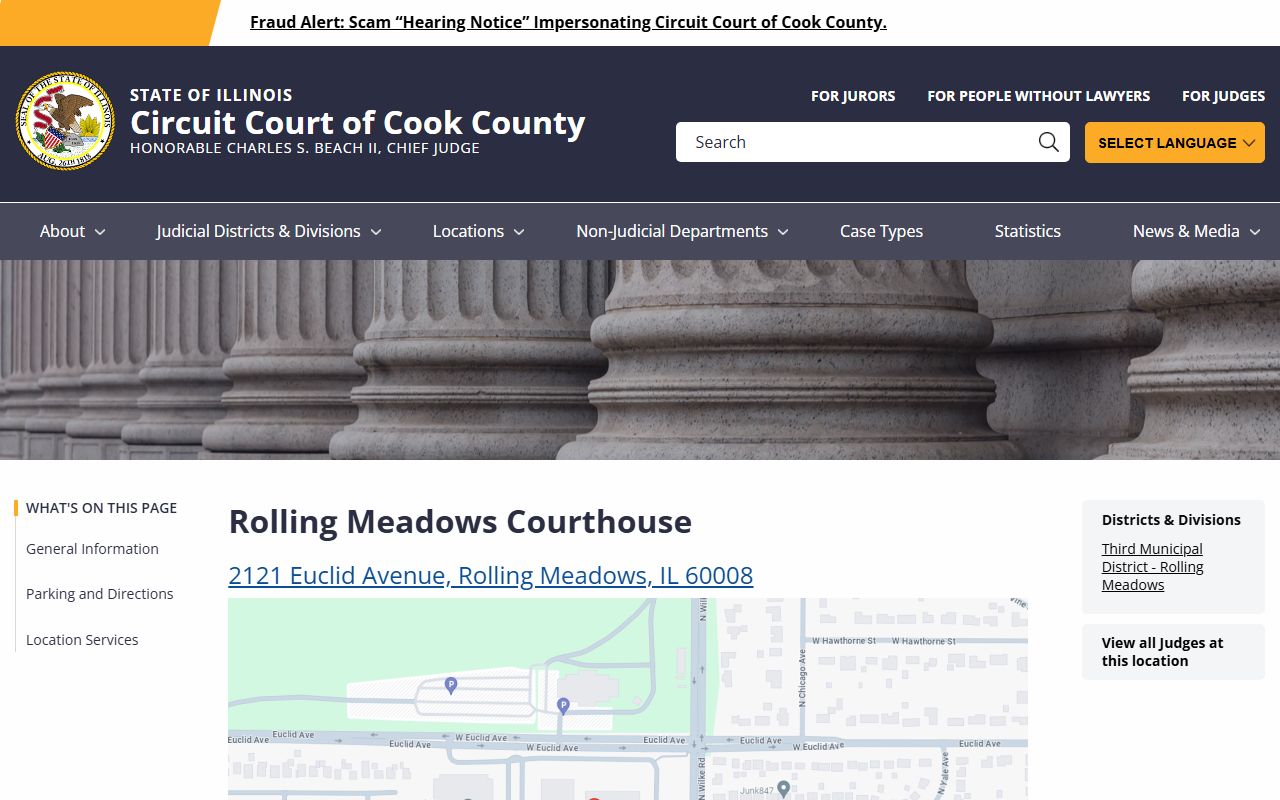
Rolling Meadows - 3rd District
2121 Euclid Avenue
Rolling Meadows, IL 60008
(847) 818-2287
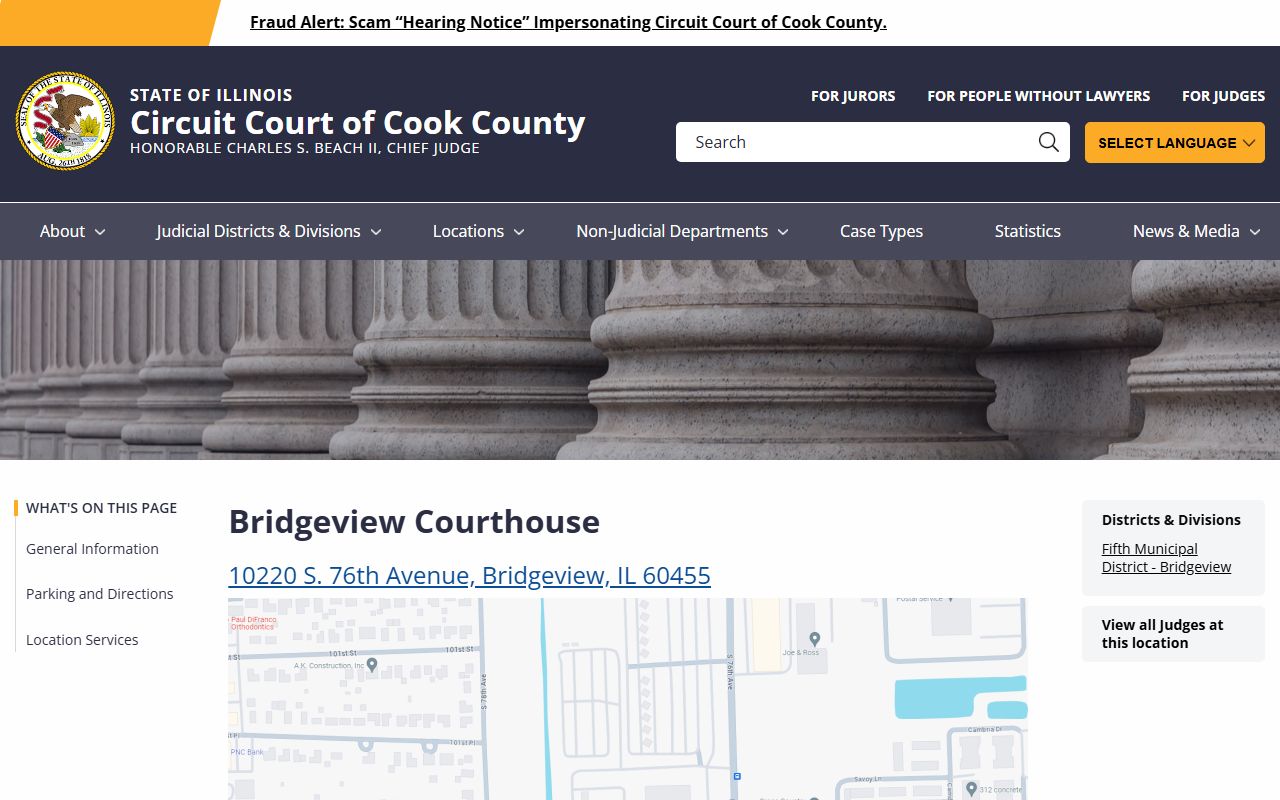
Bridgeview - 5th District
10220 S. 76th Avenue
Bridgeview, IL 60455
(708) 974-6500
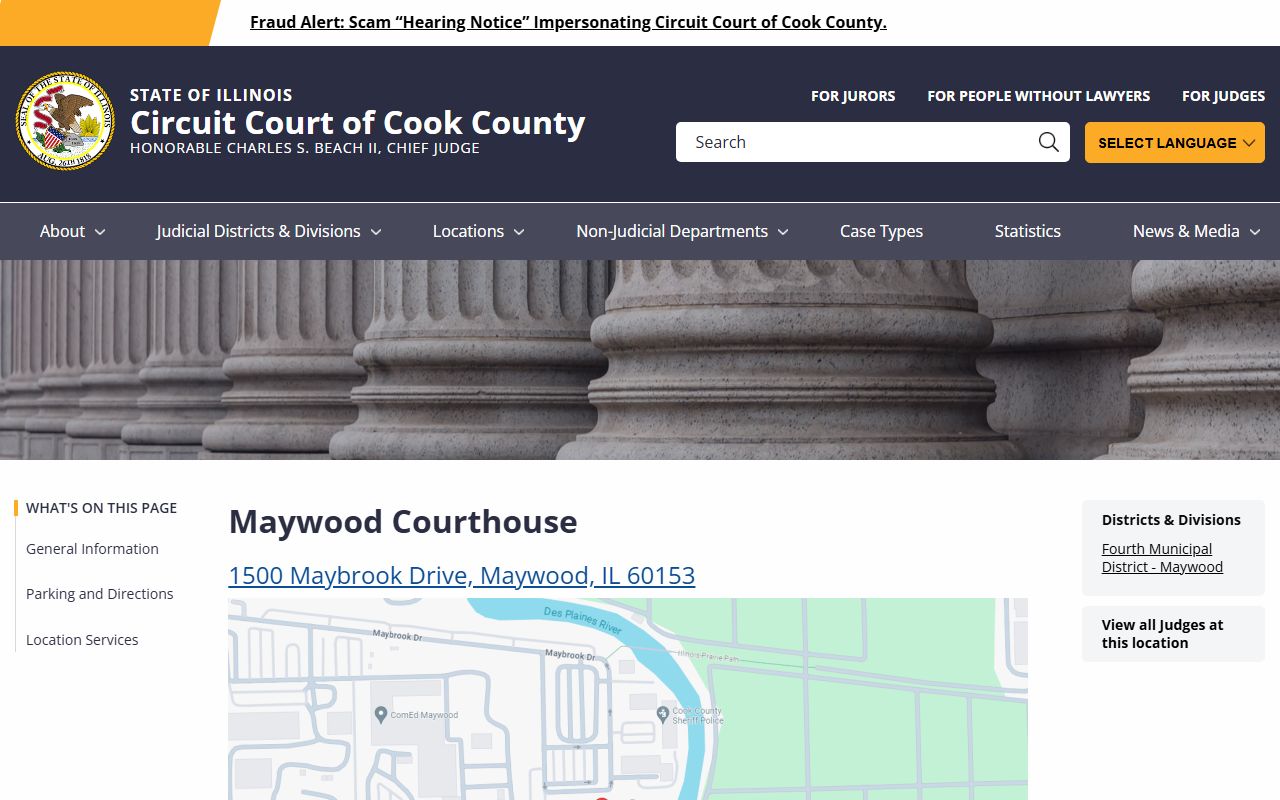
The Maywood and Markham suburban locations also handle a large share of west and south suburban traffic, misdemeanor, civil, and family cases. The Maywood Courthouse page is captured below.
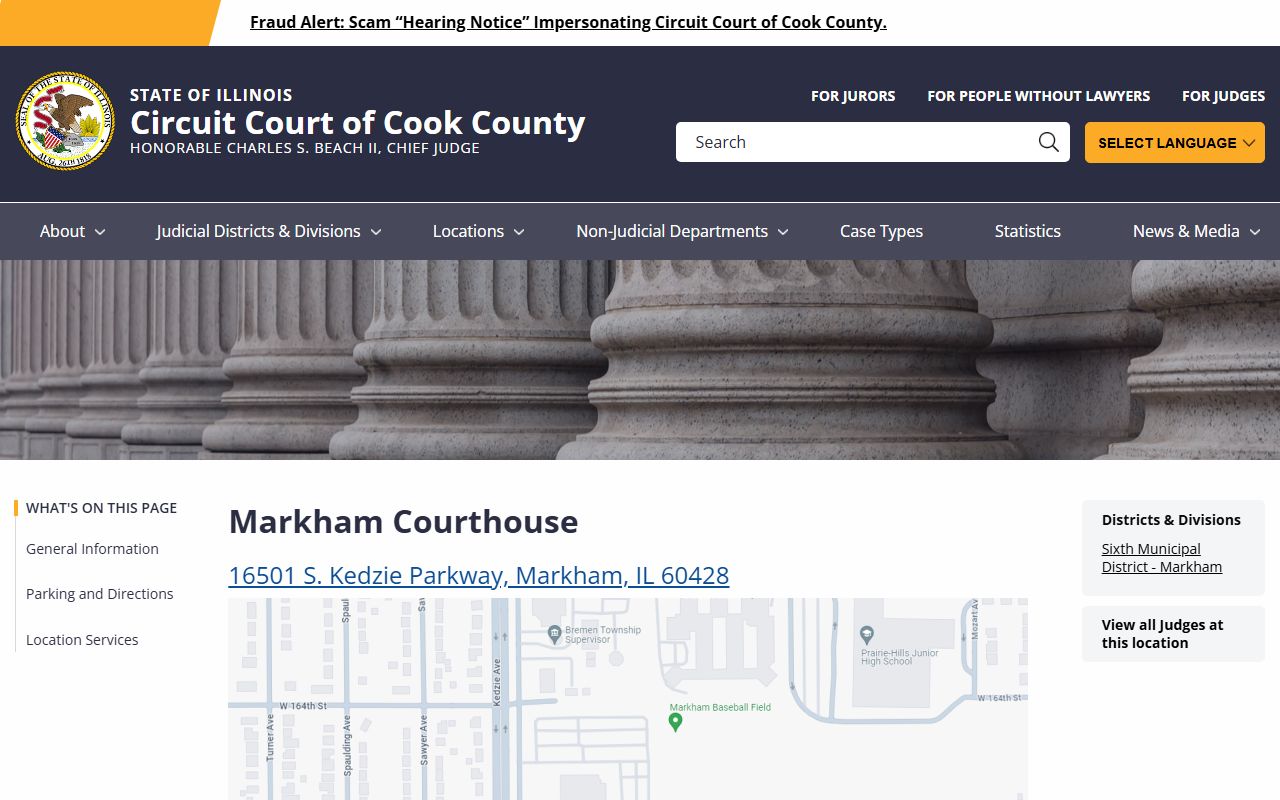
The court also lists the Rolling Meadows, Bridgeview, and Markham courthouse pages on the same official site. Each one carries its own clerk room, presiding judge, jury assembly room, children's room, lactation room, interpreter office, and remote access center for Zoom court.
The Bridgeview and Markham pages cover the southwest and south suburbs. Both list parking, transit, and accessibility services on their official pages.
More detail on each location lives on the Cook County Circuit Court page.
Types of Court Records Available in Cook County
The Circuit Court of Cook County hears civil suits, felony and misdemeanor prosecutions, traffic and ordinance matters, divorces, parentage cases, orders of protection, probate estates, guardianships, juvenile cases, tax objections, name changes, mental health proceedings, and administrative review. Each division produces its own kind of record. The Law Division hears civil suits for money damages over $30,000 in Chicago and over $100,000 in the suburban municipal districts.
Court files include complaints, summonses, answers, motions, orders, judgments, plea paperwork, and disposition entries. Some files include exhibits. Records are public unless sealed or restricted by statute or court order.
- Criminal records - Felony case files, indictments, charging instruments, bond orders, sentencing orders, probation entries, and arrest-record expungement petitions. See Cook County criminal records.
- Civil records - Law, Chancery, and Municipal Department case files for money damages, foreclosures, evictions, injunctions, and contract suits.
- Family and divorce records - Dissolution of marriage, civil-union dissolution, parentage, parenting time, child support, and orders of protection. See marriage and divorce records.
- Probate records - Wills, decedent estates, adult guardianships, and minor estates. See probate records.
- Traffic records - Citations, court dates, dispositions, and conviction reporting handled by the Traffic Section and the suburban districts.
- Court dockets - Public docket summaries that show event entries, hearing dates, and case status.
What Cook County Court Records Show
A typical Cook County docket is built from short event entries. The Clerk calls the online version a public docket summary. It is not the official copy. The official copy is the paper file at the courthouse or in another Clerk repository. The online docket still shows enough to answer most questions about case status, court date, judge, and party identity.
The table below explains the fields that show up most often on the public docket. Personal identity information is redacted under Illinois Supreme Court Rule 138.
| Field | What It Shows |
|---|---|
| Case Number | Year, division code, and sequence. CH for Chancery, L for Law, P for Probate, OP for order of protection. |
| Filing Date | Date the case was opened with the Clerk. |
| Parties | Plaintiff and defendant, or petitioner and respondent. People of the State of Illinois v. defendant in criminal cases. |
| Judge / Courtroom | Assigned judge, room, branch, and municipal district where known. |
| Case Status | Active, closed, disposed, on appeal, or transferred. |
| Docket Events | Complaint filed, motion filed, hearing set, order entered, continuance, judgment, dismissal, sentencing, warrant issued or quashed. |
| Future Court Dates | Date, time, courtroom, and hearing type when scheduled. |
| Financial Fields | Fines, fees, costs, restitution, civil judgment amount, fee-waiver entries. |
Public Access Laws for Cook County Court Records
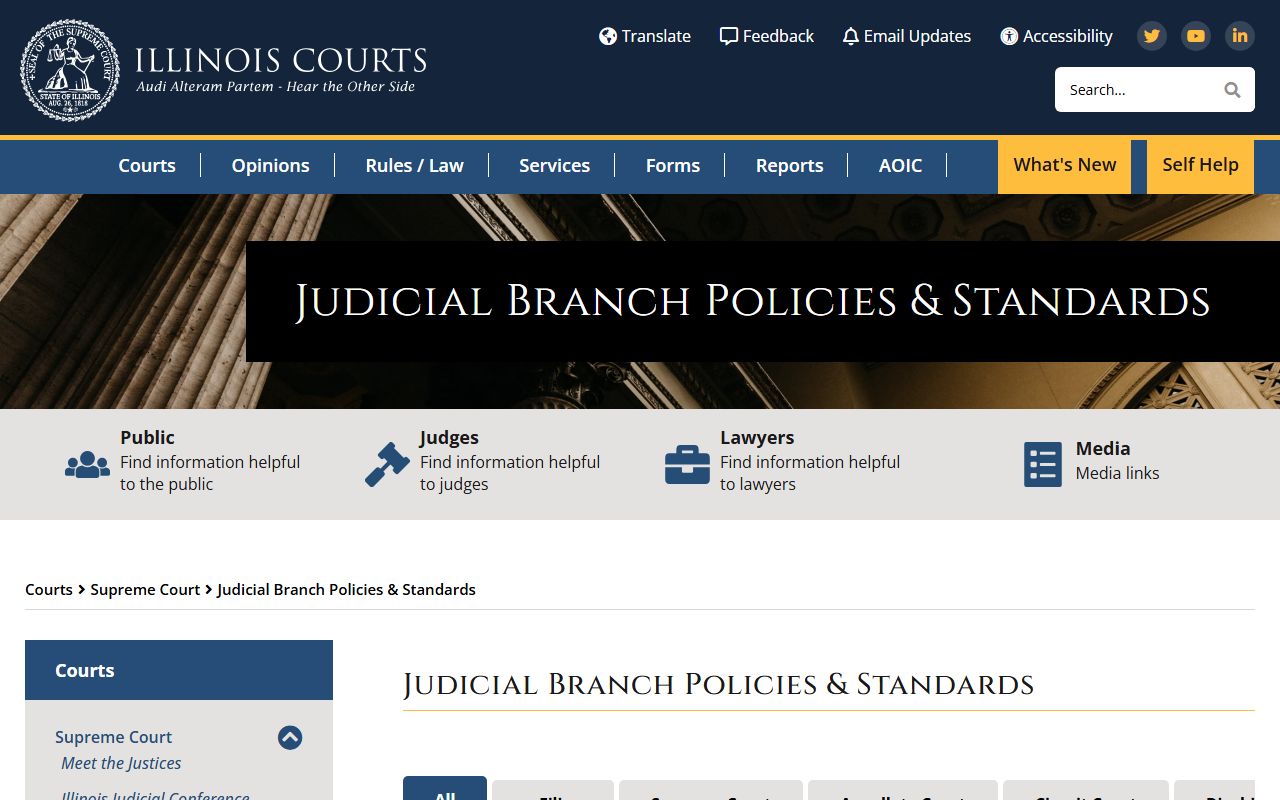
Cook County court records are public under a mix of Illinois statutes, Illinois Supreme Court rules, and Clerk policies. Court case files are not run through ordinary FOIA in the same way as agency files. The Illinois Supreme Court Remote Access Policy sets the boundaries for electronic access, and Rule 138 of the Supreme Court Rules requires that personal identity information be omitted from public filings. The Illinois Courts news release below describes the May 2025 free remote-access expansion for reviewing-court records.
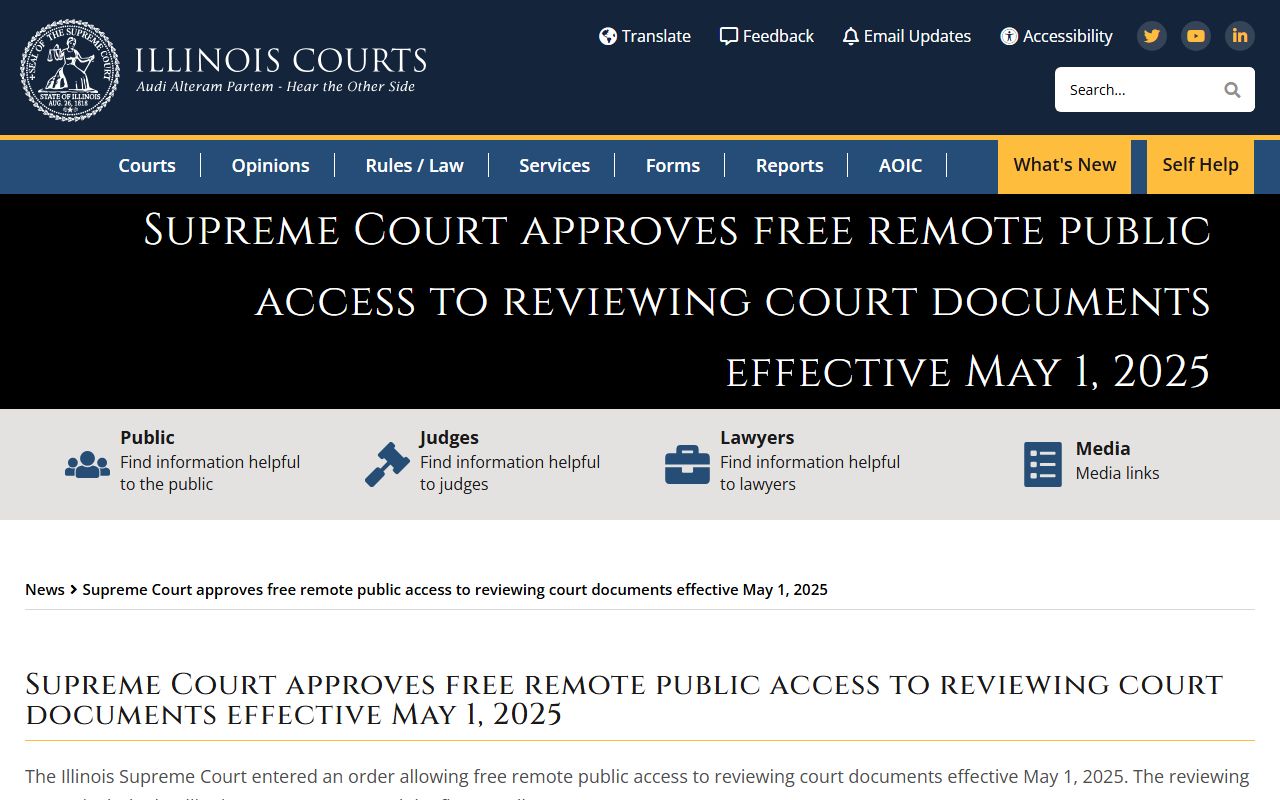
The full Remote Access Policy is at illinoiscourts.gov; that PDF explains which records remain confidential. The screenshot below shows the policy document referenced by the Illinois Courts.
Key Statutes:
5 ILCS 140 - Illinois Freedom of Information Act, which governs records held by public bodies and supports public-access reviews through the Attorney General's Public Access Counselor.
705 ILCS 105 - Illinois Clerks of Courts Act, which controls Clerk duties, fees, and record functions. Section 27.2A is the fee-and-fine collection authority.
20 ILCS 2630/5.2 - Criminal Identification Act, which governs expungement and sealing of arrest and court records and is the basis for the Criminal Division expungement petitions.
Illinois Supreme Court Rule 138 - Personal identity information rule that keeps Social Security numbers, account numbers, and dates of birth off the public file.
Records That Are Restricted or Confidential
Some Cook County records are closed by statute. The Juvenile Court Act keeps most juvenile justice and child-protection records confidential under 705 ILCS 405. The Adoption Act seals adoption files. Grand-jury matters are secret under 725 ILCS 5/112-6, even though the indictment itself becomes public. Mental health, sex-offense victim, and trade-secret material are restricted under matching exemption rules.
Sealed and expunged criminal records are governed by the Criminal Identification Act. The Criminal Division of the Circuit Court hears arrest-record expungement petitions. After an order is entered, the Clerk transmits it to law enforcement, the Illinois State Police, and other listed agencies, so public access is removed or restricted.
Domestic violence files may show docket information while addresses and safety details stay redacted. Some financial affidavits in family cases are filed in confidential form.
Specialty Courts in Cook County
The Circuit Court runs a set of problem-solving courts for treatment-oriented case handling. The mental health branch helps people arrested for nonviolent, nonsexual felonies who have mental health needs or substance use issues. Drug treatment court and veterans treatment court use the same shared model: court reviews, treatment plans, testing, and graduation.
Restorative Justice Community Courts sit in Avondale, Englewood, North Lawndale, and Sauk Village. They handle some lower-level criminal matters through repair agreements and accountability conferences rather than ordinary plea bargaining. The Criminal Division administrative orders also list a new Gun Accountability Program Court added under General Administrative Order 2026-02.
Cook County Sheriff and Jail
Sheriff Thomas Dart runs the Cook County Department of Corrections at 2700 S. California Avenue. The jail complex is a campus with several active divisions. The Sheriff's Individual in Custody Locator at iic.ccsheriff.org is the only official public lookup tool. The locator uses reCAPTCHA. Search by full first and last name, or by booking ID without hyphen.
For a complete walk-through of the locator, jail facilities, and visitation rules, see Cook County inmate records. For people no longer in custody, see released inmates. For jail-population data and capacity figures, see jail population. For active warrants and outstanding holds, see warrant records.
Marriage, Divorce, and Probate Records
Cook County uses a split clerk system. The Clerk of the Circuit Court keeps court files. The Cook County Clerk keeps vital records, including marriage and civil-union certificates. A marriage license from the County Clerk is $60 and is valid for 60 days in Chicago and suburban Cook County. Divorce cases are filed in the Domestic Relations Division at the Daley Center. For full coverage, see marriage and divorce records, the Cook County Clerk, and probate records.
- Testator
- The person whose will is filed in probate.
- Executor
- The person named in the will to manage the estate.
- Administrator
- The person appointed by the court to manage an estate when there is no executor.
- Intestate
- Dying without a valid will. The Probate Act sets out who inherits.
- Letters of Office
- The court's order showing the executor or administrator has legal authority to act for the estate.
- Guardianship
- A probate case to manage the affairs of a minor or a disabled adult.
Cook County Court Records Fees
The Clerk of the Circuit Court publishes its fee schedule on the CCG0140 form. Fees are statutory under 705 ILCS 105/27.2A. The County Clerk publishes vital-record fees on its marriage, civil-union, and genealogy request forms.
| Item | Amount |
|---|---|
| Record search fee (Clerk) | $6 per year searched |
| Plain copy, first page | $2 |
| Plain copy, each additional page | $0.50 |
| Certified copy of probate letters or court orders | $2 |
| Expungement petition (Criminal and Traffic) | $60 |
| Marriage license (County Clerk) | $60 |
| Certified marriage or civil-union certificate, first copy | $15 |
| Genealogy birth certificate older than 75 years | $15 first copy, $4 each additional |
Note: Fees change. Check the current Clerk fee schedule before you pay or mail in a request.
How to Interpret Cook County Court Records
Case numbers in Cook County are built from the year, a division code, and a sequence. CH is Chancery. L is Law. P is Probate. M is Municipal. D often appears for family cases. OP is an order of protection. JV is juvenile, but juvenile records are not public. TR or DT covers traffic and driving-related references. AD is adoption and is sealed.
Dispositions are written as guilty, not guilty, dismissed, dismissed with prejudice, dismissed without prejudice, supervision, conviction, or default. Bond entries on older cases may show cash bond or D-bond posted. After September 18, 2023, Illinois pretrial reform changed the bond system, so new cases use pretrial release or detention rather than cash bond. An arraignment entry shows when charges were read. A continuance shows a court date was moved. A bench warrant shows the court ordered an arrest, often for failure to appear.
An "information" is a prosecutor's felony charging document. An "indictment" is a grand jury's charge. The two appear in different criminal case histories. Civil judgments show the amount, the prevailing party, and whether the order is final or interlocutory.
Accuracy and Record Limitations
The Clerk's site states that online case information may take a few days to update. A very fresh filing may appear on a Public Access Terminal inside the courthouse before it appears online. If a field is blank, the Clerk says the office likely does not hold responsive data in its master database.
Note: Confirm any case fact through the Clerk before you rely on the online docket for legal, financial, or background-check decisions.
History of Cook County Courts
Before the modern Illinois Constitution, Cook County had several separate trial courts: Circuit Court, Superior Court, Criminal Court, county courts, probate courts, municipal and city courts, and justice of the peace courts. The 1962 judicial article and later constitutional changes folded all of those into a single unified Circuit Court. That is why Cook County now has divisions and municipal districts rather than separate trial courts.
The Clerk has moved through a long technology arc, from a county mainframe to e-filing through eFileIL, public online dockets, and the CCC Portal. Clerk Mariyana Spyropoulos took office on December 2, 2024 and has promoted live chat, language access for more than fifty languages, a new public data dashboard, and the move off the mainframe.
Recent Cook County Court Changes
The Clerk's e-Citation pilot is reducing moving violation processing from 7-10 days to 24-48 hours for participating municipalities. The pilot does not cover camera or parking tickets. The pilot list includes Chicago-area suburbs from Arlington Heights and Cicero to Tinley Park and Wilmette. See traffic court records for the full list and how to pay or contest a ticket.
The Illinois Supreme Court approved free remote public access to reviewing-court documents filed on or after April 1, 2025. The service runs in re:SearchIL and went live on May 1, 2025. Cook County reviewing-court filings flow into that system.
Frequently Asked Questions
Are Cook County court records online?
Yes. The Clerk of the Circuit Court runs a public online docket. It is not the official record. Use it for general status. Order certified copies from the Clerk if you need an official document for court, immigration, or background-check use.
Why can't I find a fresh case online?
Updates may take a few days. Try the Public Access Terminal at the Daley Center, the Leighton Criminal Courthouse, the Domestic Violence Courthouse, or one of the suburban courthouses if the case is new.
Who is the current Clerk of the Circuit Court?
Mariyana T. Spyropoulos has been Clerk of the Circuit Court of Cook County since December 2, 2024. Her main office is at 50 W. Washington Street, Suite 1001, Chicago, IL 60602. The main phone is (312) 603-5030.
What is the difference between the Circuit Clerk and the County Clerk?
The Clerk of the Circuit Court holds court case files. The County Clerk holds vital records, election records, board records, and tax-extension records. The County Clerk is Monica Gordon. See the Clerk of the Circuit Court and County Clerk pages for full detail.
Where do I file for divorce?
In the Domestic Relations Division at the Daley Center for Chicago, or in the local municipal district courthouse for suburban Cook County. The main Domestic Relations phone is (312) 603-3025.
More on the Cook County Court Records FAQ page.