
Cook County Marriage License Requirements
Couples marrying in Chicago or suburban Cook County must obtain a marriage license from the Cook County Clerk. Both members of the couple must appear together at one of the Clerk's four locations. The Cook County marriage license service page is below.
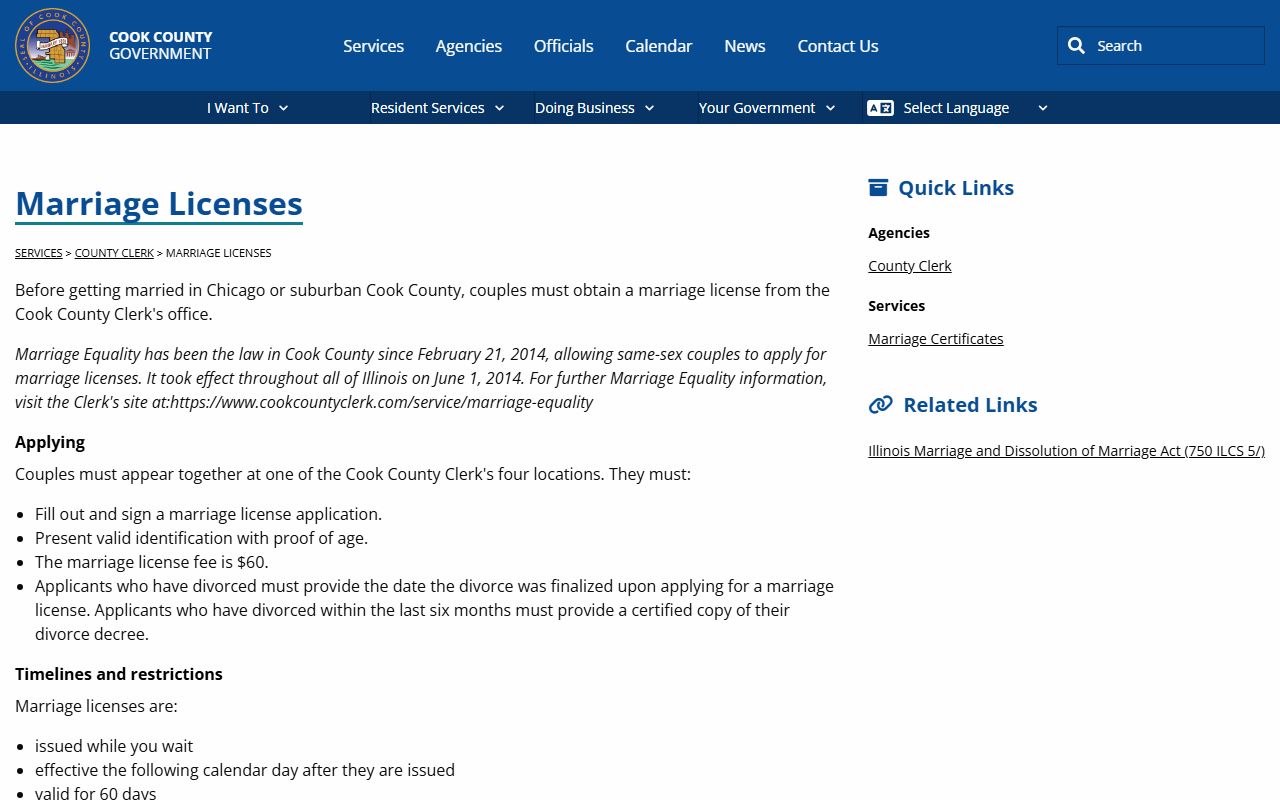
The license requirements are short. Fill out and sign a marriage license application. Present valid identification with proof of age. Pay the $60 fee. Applicants who have divorced must provide the date the divorce was finalized; applicants divorced within the last six months must provide a certified copy of the divorce decree. Marriage Equality has been the law in Cook County since February 21, 2014 and statewide since June 1, 2014.
- Make a plan with your partner to appear together at a Cook County Clerk location.
- Bring valid government-issued ID with proof of age.
- If previously divorced, bring the divorce finalization date; if divorced in the last six months, bring a certified decree.
- Complete and sign the marriage license application.
- Pay the $60 fee.
- The license is issued while you wait. It is effective the next calendar day and is valid for 60 days only in Chicago and suburban Cook County.
Cook County Marriage and Vital Record Fees
The Cook County Clerk publishes fees on the marriage and genealogy record request forms. The fee schedule below is taken from the official Marriage/Civil Union Record Request Form 2024 and the Genealogy Record Request Form 2024.
| Item | Amount |
|---|---|
| Marriage license | $60 |
| Certified standard marriage or civil-union certificate, first copy | $15 |
| Additional copy of the same record | $4 each |
| Wallet certificate set of two | $15 |
| Genealogy marriage certificate older than 50 years | $15 first, $4 each additional |
| Genealogy birth certificate older than 75 years | $15 first, $4 each additional |
| Genealogy death certificate older than 20 years | $17 first, $6 each additional |
| Additional year searched (if exact date unknown) | $1 per year, max 10 years |
Marriage / Civil Union Record Request Form Fields
The County Clerk's Marriage or Civil Union Record Request Form 2024 is used to order certified copies. The field inventory below comes from the official PDF text.
| Field Label | Type | Required | Notes |
|---|---|---|---|
| Standard Certificate requested | Checkbox / quantity | Optional | $15 first standard, 8 x 10. |
| Wallet Certificate requested | Checkbox / quantity | Optional | $15 for two wallet certificates. |
| Name of spouse / party A | Text | Required for search | Names as recorded. |
| Name of spouse / party B | Text | Required for search | Names as recorded. |
| Date of marriage or civil union | Date | Required if known | Month / day / year. |
| City, town, or village of event | Text | Required if known | Must be in Cook County. |
| Marriage / civil union license number | Text | Optional | Narrows the search. |
| Requestor name and contact | Text | Required | Mail-order contact information. |
| Payment | Check / money order | Required for mail | Payable to Cook County Clerk. |
| Return envelope | Physical item | Required for mail | Self-addressed stamped envelope per form. |
Cook County Marriage Certificate
The County Clerk is the official record keeper for marriages, civil unions, and domestic partnerships in Chicago and suburban Cook County. After the wedding, the officiant completes and signs the license, then returns it to the Clerk to be recorded. Certified marriage certificates are not automatically sent; the couple or a third party must order certified copies after recording.
Note: A certified copy is required for legal use such as a name change, immigration filing, or out-of-state recording. Plain copies are usually fine for personal use.
Cook County Divorce in the Domestic Relations Division
Divorce cases are heard in the Domestic Relations Division of the Circuit Court of Cook County. Main office: Richard J. Daley Center, 50 W. Washington Street, Chicago, IL 60602, phone (312) 603-3025. The Domestic Relations Division also handles dissolution of civil union, legal separation, invalidity, child support, allocation of parental responsibilities, parenting time, third-party visitation, parentage, enforcement, modification, and division of property.
The Domestic Relations Division page is shown below; it lists case types and contact details.
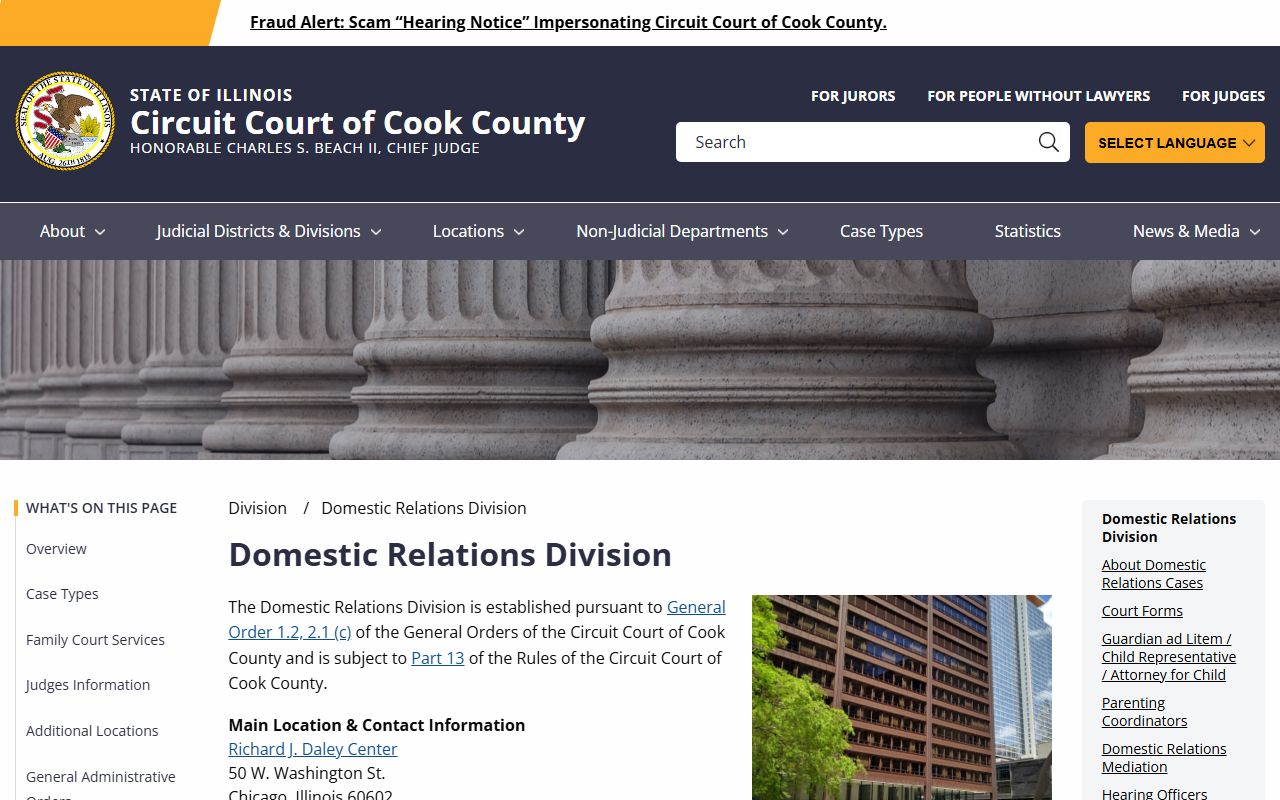
Additional locations include the Skokie, Rolling Meadows, Maywood, Bridgeview, and Markham courthouses. Each suburban courthouse hears domestic relations matters for residents in its district.
How to File for Divorce in Cook County
Cook County divorce filings follow the Illinois Marriage and Dissolution of Marriage Act, 750 ILCS 5. Most filings now use eFileIL. Self-represented litigants can use Illinois Supreme Court standardized forms.
- Confirm Illinois residency and venue in Cook County.
- Choose forms: the Illinois Supreme Court standardized divorce family forms or attorney-drafted pleadings.
- File electronically through eFileIL unless exempt or using an approved paper process.
- Pay the filing fee or request a fee waiver.
- Serve the spouse or respondent under the Illinois rules.
- Attend status, mediation, parenting class, support, prove-up, or trial dates as ordered.
- The final judgment resolves status, property and debt, support, parenting, and related orders.
Searching Cook County Divorce Records
Divorce dockets and many orders are public. Search the Clerk's online case information for general status. The full case file lives at the Daley Center or the suburban courthouse. Many family-law filings include financial affidavits, minor-child information, addresses, and abuse-related records that are redacted or restricted under Illinois Supreme Court Rule 138 and family-law confidentiality rules.
Note: Common-law marriage cannot be formed in Illinois, but Illinois may recognize valid common-law marriages from states that allow them.
Confidential Family-Law Data
Adoption case files are sealed under 750 ILCS 50, the Illinois Adoption Act. Juvenile cases are confidential under 705 ILCS 405. Financial affidavits in dissolution cases may be filed in confidential form. Address and safety information in domestic-violence-related family cases is often restricted.
The Vital Records Act, 410 ILCS 535, controls certified marriage and civil-union certificates issued by the County Clerk; the act sets eligibility for current certified copies and the genealogy thresholds for older records.
Civil Unions and Parentage Cases
The Domestic Relations Division also handles dissolution of civil union, legal separation, and invalidity. Civil unions have been recorded by the County Clerk since Illinois recognized them, and the certified-copy process matches the marriage process. Parentage cases establish legal parent-child relationships and can set support and parenting time without a marriage ever existing.
Genealogy researchers use the older vital records for family history. Marriage records older than 50 years, birth records older than 75 years, and death records older than 20 years are available as non-certified genealogy copies under the Vital Records Act thresholds. The County Clerk runs a genealogy website for these older records.