
Cook County Active Warrant Search Channels
The Sheriff's Individual in Custody Locator shows who is currently in Cook County Jail. It is not a warrant search, but the locator's terms page lists an outstanding warrant or an ICE detainer as a reason a visitor application may be denied. That confirms that the Sheriff tracks outstanding warrants and holds at the booking level.
For an open criminal case in Cook County, the Clerk's online docket may show that a warrant was issued, quashed, or recalled. For older or sealed cases, that information may not appear on the public docket. Many bench warrants are also reported into law-enforcement databases like LEADS, which are not public.
Note: Do not rely on unofficial third-party warrant lookup sites. They are not the official record and may be out of date.
Types of Cook County Warrants
Cook County uses several kinds of warrants and warrant-like orders. The terminology depends on the issuing court and the case posture.
- Arrest warrant - A judge's authorization to arrest a person accused of an offense, usually issued after a sworn complaint.
- Bench warrant - Issued by a judge, often for failure to appear, probation violation, or contempt.
- Search warrant - Authorizes search and seizure of a place, person, or device. Often sealed during an active investigation.
- Fugitive warrant - Based on another jurisdiction's warrant; may lead to extradition.
- Capias / capias-like order - A court order to bring a person before the court. Terminology varies in Illinois.
- Civil body attachment - Sometimes used in civil contempt or child-support contexts; not the same as a criminal arrest warrant.
Domestic Violence Orders and Warrants
The Circuit Court's Domestic Violence Division hears civil orders of protection, civil no-contact orders, stalking no-contact orders, and certain misdemeanors and felony preliminary matters under the Illinois Domestic Violence Act. A violation of an order of protection may lead to a new criminal case and a fresh warrant. The Domestic Violence Division page below covers protective-order case types.
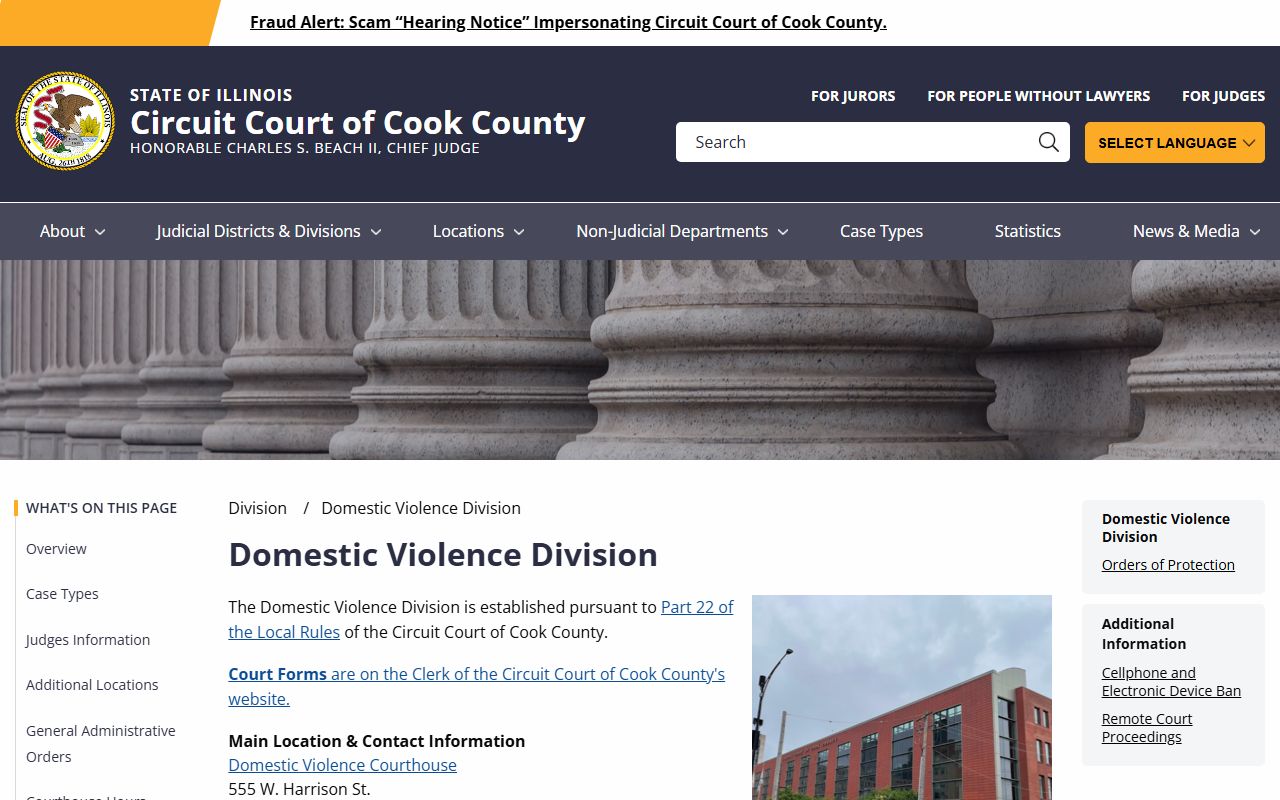
The Domestic Violence Courthouse is at 555 W. Harrison Street and uses an after-hours remote hearing path for civil emergency orders of protection on weeknights, weekends, and outside regular court hours.
How to Confirm a Cook County Warrant
Do not rely on rumor. Confirm a warrant through an official channel before acting. A confirmed bench warrant means you may be arrested at any traffic stop or interaction with police.
- If a Cook County criminal case number is known, search the Clerk's online docket for a "warrant issued" entry and any later "warrant quashed" or "warrant recalled" entry.
- For an active jail status check, search the Sheriff's Individual in Custody Locator.
- Call the Sheriff's automated help line at 773-674-5245 to check custody status or pay an older cash bond.
- Contact a lawyer or the Cook County Public Defender for procedural advice before voluntary surrender.
- Contact the Clerk's Office for procedural questions about the case file.
- For a warrant in a different Illinois county, contact that county's circuit clerk or sheriff.
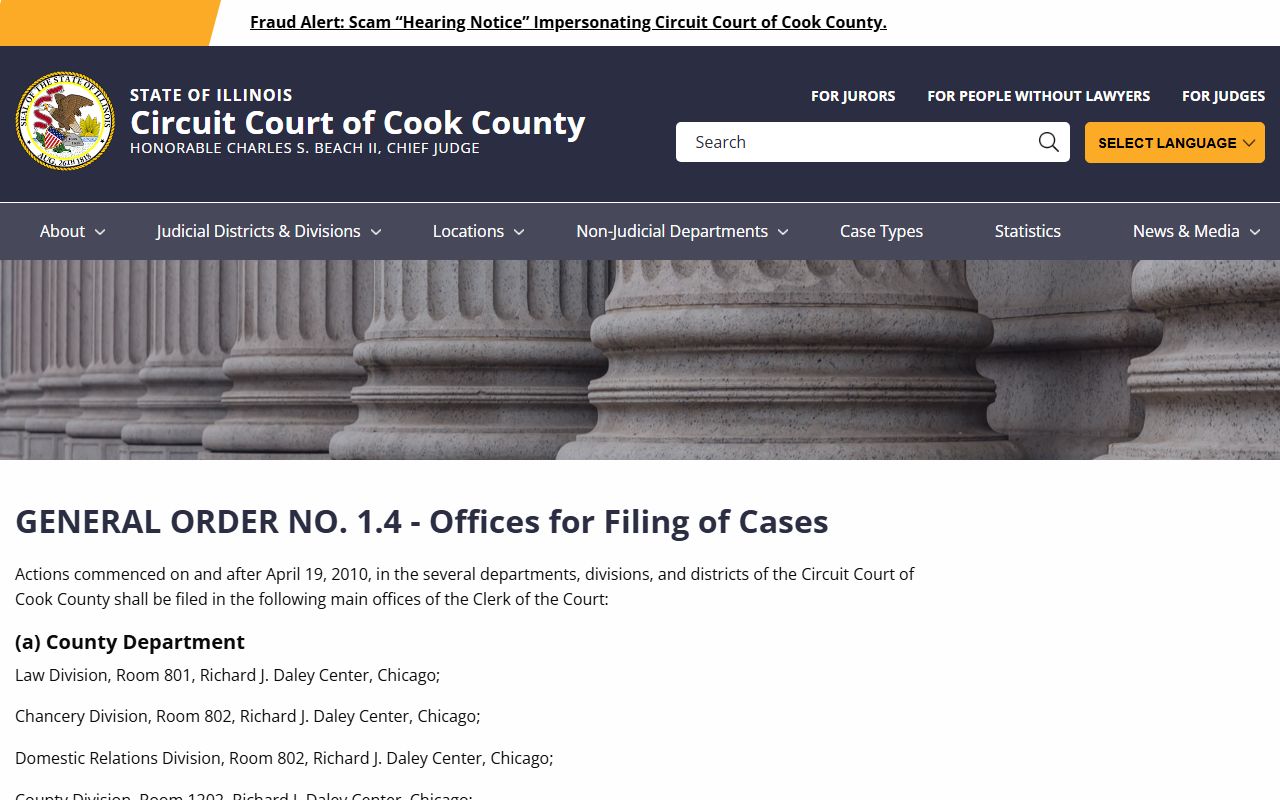
The General Order 1.4 filing-locations page below describes where felony, civil, traffic, and Domestic Violence matters are filed in Cook County and is useful for identifying the right courthouse for a case-related warrant.
Cook County Sheriff and Warrant Holds
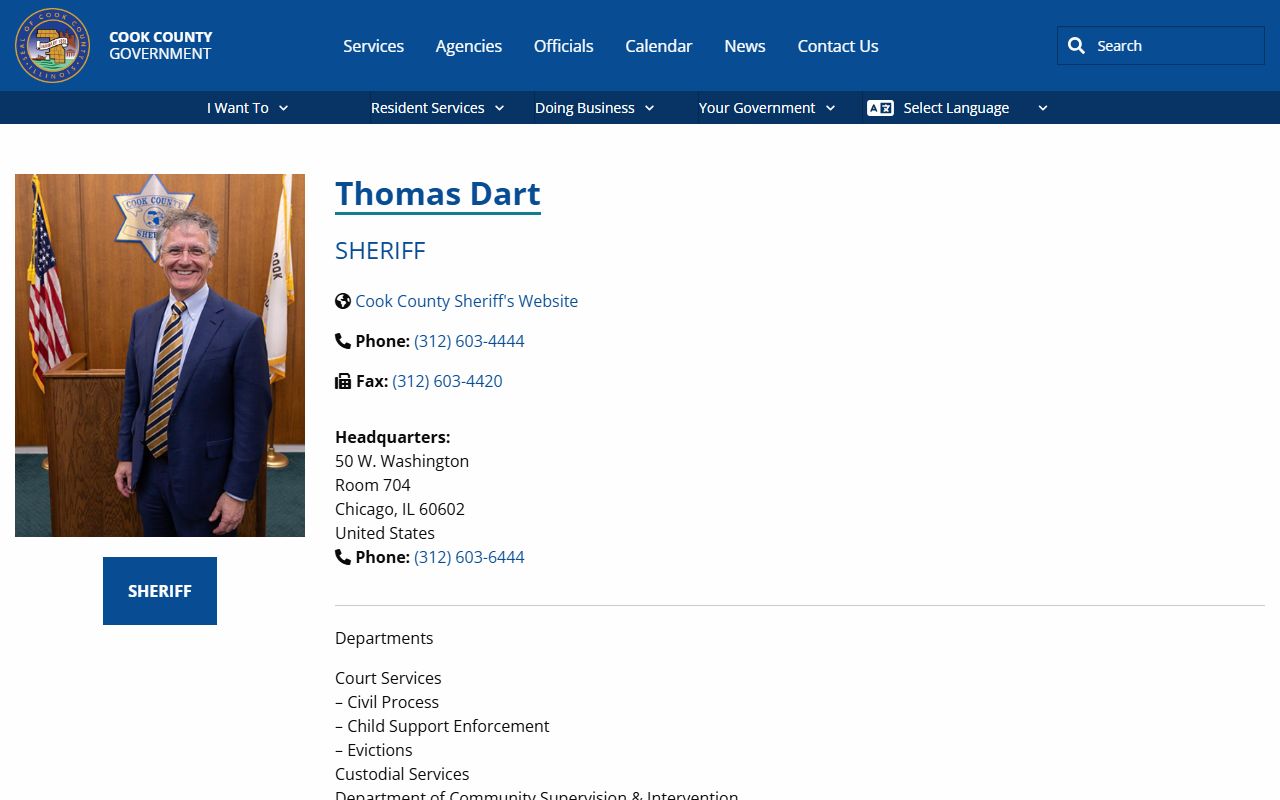
Sheriff Thomas Dart runs the Cook County Department of Corrections at 2700 S. California Avenue. The Sheriff's government profile page is below.
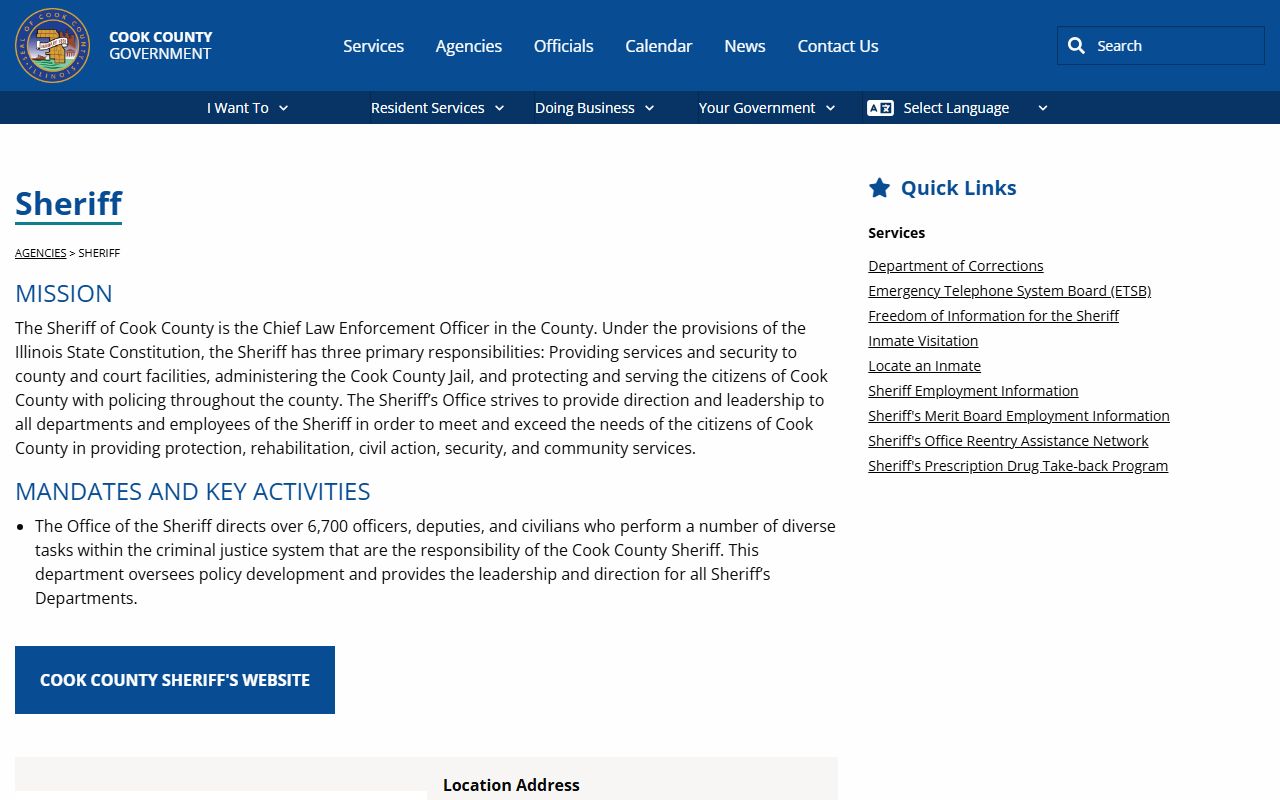
The official Sheriff Thomas Dart profile page is below and identifies the elected Sheriff and the department mission.
If a Cook County inmate has a hold from another agency, bonding cannot begin until the poster is present, because the Sheriff needs additional information from that agency. ICE detainers, out-of-state holds, and Illinois Department of Corrections holds can each delay release.
How to Resolve a Cook County Warrant
Resolving a warrant is fact-specific, but the steps below are a general checklist. Failure to appear is one of the most common reasons for a bench warrant, and many can be quashed with the right motion.
- Identify the issuing court, case number, charge, and any agency hold.
- Talk to a lawyer or the Public Defender if you qualify.
- If failure to appear caused the warrant, file a motion to quash or recall the warrant where the case rules allow.
- If arrest is likely, arrange transportation, childcare, medication, and attorney contact before surrender.
- For older cash-bond cases filed before September 18, 2023, confirm whether bond is still required and where it can be posted.
- After the court recalls or quashes the warrant, keep certified copies of the order until law-enforcement databases update.
Bonding, Trust Accounts, and Property
For older cash-bond cases, Division 5 at 2700 S. California Avenue accepts bond from 10 a.m. to 6 p.m., 365 days a year. The Sheriff also accepts bonds at the Skokie, Rolling Meadows, Maywood, Bridgeview, and Markham courthouses Monday-Friday, 8:30 a.m. to 3 p.m. Acceptable payment methods include cash, bank or cashier's checks, and credit or debit card in-person at 2700 S. California with a 2.13% non-refundable service fee.
After bond is posted, discharge takes approximately 2 to 3 hours. Time may increase if GPS monitoring is required. The Sheriff's trust account page below covers commissary, kiosk deposits, and former-detainee fund pickup.
Sheriff Corrections FAQ
The Sheriff's corrections FAQ covers visitation, mail, trust accounts, property, programming, and release. The page below is the official starting point for procedural questions tied to a custody or warrant matter.
Bench Warrants and Failure to Appear
The most common warrant in Cook County is a bench warrant for failure to appear. When a defendant misses a scheduled court date, the judge can issue a bench warrant on the spot. The case docket usually shows a "warrant issued" entry, and later a "warrant quashed" or "warrant recalled" entry if the person returns to court and the judge lifts it.
A bench warrant does not expire on its own. It stays active in law-enforcement databases until the court recalls it. That is why a years-old missed traffic or misdemeanor date can still lead to an arrest at a routine traffic stop. The fix is to appear in court or file the right motion, not to wait it out.
Out-of-State Holds and Extradition
A fugitive warrant is based on another state's warrant. If Cook County picks up a person wanted elsewhere, the Sheriff can hold that person while the demanding state decides whether to extradite. Extradition in criminal matters is handled through the Criminal Division of the Circuit Court, which hears habeas corpus and extradition issues. ICE detainers work differently and are placed by federal immigration authorities, not by the court.
Note: An out-of-state hold or ICE detainer can block release even after Cook County conditions are satisfied.
Sex Offender Registry
The Illinois State Police sex offender registry at isp.illinois.gov/Sor is the official statewide registry. A failure to register may generate a new criminal warrant. Registry search and update procedures are separate from the Cook County warrant system, even though the case files overlap.